
Thailand Industry Report
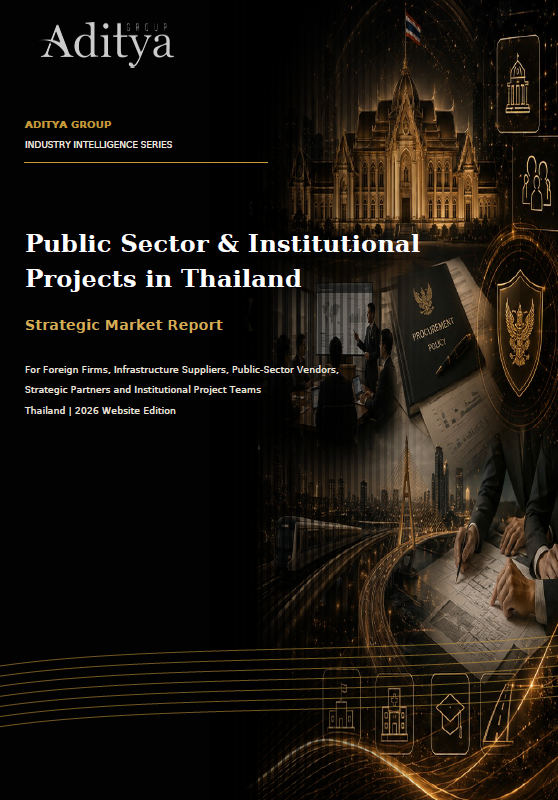
Public Sector & Institutional Projects in Thailand
Comprehensive insights into the Thailand industry landscape, covering market dynamics, key trends, opportunities, and how businesses can grow and succeed in this evolving market.
Market
Intelligence
Strategic
Insights
Opportunity
Analysis
Informed
Decisions
PPP pipeline THB 1.09T
Market Signal
Procurement-led; 7+ trends
Key Trends
PPP, digital government, infrastructure, utilities
Growth Drivers
Very High
Strategic Relevance
Thailand's public sector and institutional project market is large, strategically important and complex. It includes ministries, departments, provincial administrations, local authorities, public organizations, state enterprises, universities, hospitals, public utilities, transport authorities, digital government agencies, government-linked buyers and PPP project vehicles. Opportunities exist in infrastructure, ICT, digital government, healthcare facilities, education facilities, public utilities, transport systems, environment, energy, security, institutional procurement and public service modernization
File Size: 2.4 MB
PDF / DOC
Detailed analysis, data insights, and expert perspectives.
Increasing domestic and international demand across key segments.
Innovation and digital adoption are reshaping the industry.
ESG and green practices driving responsible
growth.
Government initiatives and incentives boosting investor confidence.
Strong export outlook with access to global markets.
Market Entry
End-to-end support for successful market entry.
Strategic Advisory
Actionable strategies to accelerate growth and competitiveness.
Business Matching
Connect with the right partners and opportunities.
Sourcing & Supply Chain
Reliable sourcing and efficient supply chain solutions.
Regulatory Guidance
Navigate regulations and compliance with confidence.
Growth Partnerships
Long-term partnerships to unlock sustainable growth.
Thailand’s public sector and institutional project market is large, strategically important and complex. It includes ministries, departments, provincial administrations, local authorities, public organizations, state enterprises, universities, hospitals, public utilities, transport authorities, digital government agencies, government-linked buyers and PPP project vehicles. Opportunities exist in infrastructure, ICT, digital government, healthcare facilities, education facilities, public utilities, transport systems, environment, energy, security, institutional procurement and public service modernization.
The opportunity is not simply about finding tenders. Thailand’s public-sector market requires understanding of policy priorities, budget cycles, procurement methods, Thai-language documentation, local qualification requirements, reference expectations, agency culture, compliance rules, price scrutiny, partner credibility and execution risk. Foreign companies that treat public projects as ordinary B2B sales often fail because they enter too late, choose the wrong partner, misunderstand specifications, or underestimate the institutional process.
Thailand’s procurement framework is governed by the Public Procurement and Supplies Administration Act B.E. 2560 (2017), while public-private partnership projects are structured under the PPP framework administered through the State Enterprise Policy Office. SEPO’s PPP Delivery Plan 2020-2027 identified 92 PPP projects with projected investment of THB 1.09 trillion, including high-priority transport, infrastructure and public-service projects. Public investment remains relevant to national growth, with NESDC projecting public investment growth of 3.1% in 2026, albeit slower than the previous year.
For Aditya Group, this sector is relevant because many foreign and local clients need a trusted Thailand-side advisor who can interpret the market, identify the right public-sector route, qualify partners, assess tender feasibility, coordinate local execution, and avoid reputational or compliance mistakes. The group’s value lies in converting broad public-sector interest into a disciplined opportunity pipeline, credible local positioning and practical implementation support.
This report defines Public Sector & Institutional Projects as projects, procurements and programs led, funded, regulated or significantly influenced by Thai government bodies, state enterprises, public organizations or institutional buyers. It includes traditional public procurement as well as PPP, concessions, framework contracts, pilot projects, donor-backed programs and institutional sales to government-linked organizations.
What is included
- Central government procurement: ministries, departments and national agencies buying goods, services, works, systems and consulting support.
- State enterprise projects: utilities, transport, energy, telecom, ports, airports, rail, water and other public-service enterprises.
- Local government and provincial projects: municipalities, provincial administrations and local public works or service programs.
- Public institutions: universities, public hospitals, research centers, public organizations and government-linked institutes.
- PPP and concession projects: transport, utilities, digital infrastructure, facilities, waste, energy, urban systems and public-service assets where private investment or operation is part of the model.
- Digital government and e-services: portals, data infrastructure, cybersecurity, workflow digitization, citizen services, digital ID, document management, cloud and systems integration.
- Development-bank and donor-linked programs: projects involving ADB, World Bank, JICA, UN agencies or regional cooperation programs where procurement discipline and documentation standards are high.
- Institutional supply: equipment, technology, vehicles, devices, construction materials, furniture, training, maintenance and service contracts for public/institutional buyers.
What is outside the scope
This report does not cover political lobbying, informal procurement practices or public-sector work outside Thailand. It also does not treat public projects only as infrastructure construction; the scope includes institutional procurement, digital systems, consulting, technology, services and project delivery models.
Cluster | Typical project types | Client implications |
Transport and mobility | Rail, roads, expressways, airports, ports, ticketing, traffic systems, fleet solutions and asset maintenance. | Large opportunities, long cycles, strict qualification requirements and consortium-driven execution. |
Utilities and environment | Water, wastewater, waste-to-energy, renewable energy, grid, fuel, public lighting and environmental monitoring. | Requires technical references, regulatory understanding and lifecycle cost credibility. |
Digital government | Citizen portals, cloud, data exchange, cybersecurity, document management, workflow systems and institutional software. | Strong demand but high scrutiny around security, integration and long-term support. |
Healthcare and education institutions | Hospital equipment, facilities, management systems, university systems, training, research equipment and service contracts. | Institution-specific requirements; reference and after-sales capability are essential. |
Local government and provincial projects | Municipal services, urban systems, public works, tourism facilities, community facilities and local digitization. | Fragmented market; requires local knowledge, Thai-language engagement and partner presence. |
State enterprises | Energy, telecom, transport, ports, airports, water and large public services. | Often more commercially sophisticated, but still procurement and governance intensive. |
Public-sector projects can create strong credibility and scale, but they also carry higher documentation, timing, payment, compliance and reputational risk than ordinary private-sector sales. Clients need a structured risk review before investing heavily in a tender or institutional sales campaign.
Risk | How it appears | Mitigation approach |
Tender misfit | The company spends time on tenders it is unlikely to win because requirements were not understood early. | Pre-screen opportunities against qualifications, references, pricing, local service and agency priorities. |
Weak local partner | Partner has access but lacks delivery capability, or has delivery capability but no public-sector credibility. | Run partner due diligence, reference checks and role clarity before signing. |
Specification mismatch | Product or service fails mandatory TOR clauses, certificates or after-sales conditions. | Prepare compliance matrix and technical clarification early. |
Budget and timing delays | Project approval, award or payment is delayed due to budget, administrative or political factors. | Build realistic timeline, cashflow buffer and staged commercial assumptions. |
Compliance exposure | Improper conduct by agents, subcontractors or sales intermediaries creates legal or reputational risk. | Use written engagement scopes, anti-corruption clauses and clean documentation. |
Currency and cost risk | Imported equipment, long validity periods and delayed awards create FX or margin pressure. | Use quotation validity, escalation terms and supplier confirmation. |
Implementation failure | Installation, training, support or acceptance criteria are not properly managed. | Set project governance, milestones, acceptance documents and local support plan. |
Data/security risk | Digital projects involve personal data, security, access control and hosting issues. | Include PDPA, cybersecurity and data-governance review in solution design. |
Thailand’s public-sector project environment includes local contractors, Thai system integrators, state-enterprise vendors, foreign suppliers, global engineering firms, law firms, development consultants, distributors, equipment suppliers, EPC companies, technology integrators and consortium partners. The most successful players combine technical credibility with local execution capability.
Operating realities
- Tender cycles can be slow. Agencies may conduct market sounding, budget approval, TOR preparation, tendering, evaluation, award, contract negotiation and delivery across many months or years.
- Specifications matter. A vendor can be excluded if product features, certificates, references, Thai documentation or after-sales arrangements do not match the TOR.
- Lowest price is not always the full story, but value-for-money and compliance are central. Public buyers must justify evaluation decisions.
- Thai-language communication is critical. Translation alone is insufficient when technical clarifications, site meetings and agency coordination are needed.
- Local references and service capability increase confidence, especially for technology, equipment and systems requiring support after installation.
- Public projects have reputational risk. Partner selection, pricing behavior, gift policies, subcontracting and documentation must be clean and defensible.
- Foreign companies need to decide whether to bid directly, appoint a representative, form a JV/consortium, license technology, or work through a Thai prime contractor.
Market participant map
Participant type | Strengths | Common limitations |
Thai prime contractors / integrators | Agency access, Thai documentation, tender experience and local delivery teams. | May need foreign technology, specialized expertise or international references. |
Foreign technology/equipment vendors | Strong product, patents, global references and technical differentiation. | Often weak on Thai documentation, local service, agency relationships and tender process. |
State-enterprise vendors | Deep understanding of specific public-service sectors and recurring institutional relationships. | May be limited to traditional products or slower innovation. |
Consulting and advisory firms | Feasibility, strategy, process design and project-management support. | May not execute commercial sourcing or operational coordination. |
Local distributors | Existing sales channels, import support and local billing. | May lack strategic positioning or capability for complex public projects. |
Public-sector opportunity in Thailand is strongest where a private company can solve a real public-service problem, reduce operating cost, increase transparency, improve citizen experience, enhance safety, or support national competitiveness. The most attractive opportunities are rarely isolated tenders; they are opportunity pipelines that begin with policy mapping, agency need analysis, budget monitoring and partner qualification.
High-potential opportunity areas
- Digital government and institutional software: e-services, workflow systems, document management, cybersecurity, data platforms, call centers, portals, analytics and public-sector CRM/service tools.
- Infrastructure and mobility: transport systems, public works support, smart ticketing, traffic management, fleet systems, EV charging, maintenance services and construction-related institutional supply.
- Healthcare institutions: equipment, hospital systems, elderly care infrastructure, patient management, logistics, facility services and specialized products for public and university hospitals.
- Education and research institutions: laboratory equipment, campus technology, training platforms, vocational-skills support, smart classrooms and research commercialization support.
- Environmental and utility projects: water, wastewater, solid waste, recycling, air-quality monitoring, energy efficiency, renewable energy and public lighting.
- State enterprise modernization: asset management, enterprise systems, cybersecurity, operational efficiency, customer service systems, procurement support and maintenance technology.
- Institutional sourcing and procurement support: verified suppliers, product qualification, technical comparison, specification preparation, market sounding and sourcing from Thailand or abroad.
- PPP and concession advisory support: project screening, market sounding, partner mapping, feasibility support, consortium formation and local execution coordination.
Client need | Aditya Group support | Expected outcome |
Public-sector market assessment | Map agencies, policy priorities, budgets, procurement routes, competitors and potential projects. | Clear opportunity landscape and priority target list. |
Bid/no-bid decision support | Review tender fit, qualification requirements, pricing risk, local support need and partner requirement. | Reduced wasted effort and sharper pursuit discipline. |
Partner identification | Identify, screen and shortlist Thai distributors, integrators, contractors, consultants or consortium partners. | Better local representation and lower execution risk. |
Thailand localization | Prepare local positioning, Thai-market narrative, capability pack, reference presentation and agency-specific messaging. | Improved credibility with institutional buyers. |
Procurement-readiness support | Create compliance matrix, documentation checklist, tender response coordination and submission support with Thai partners. | More professional, complete and defensible bid preparation. |
Institutional sales strategy | Build a non-pushy approach for public institutions, state enterprises, universities, hospitals and agencies. | Relationship-led, compliant opportunity development. |
Execution coordination | Coordinate local vendors, site visits, installation, training, reporting, acceptance and after-sales support. | Higher chance of smooth delivery after award. |
PPP / project structuring support | Support market sounding, consortium mapping, feasibility coordination and local stakeholder understanding. | More realistic long-cycle project development path. |
Recommended Aditya Group service modules
- Public Sector Opportunity Scan: 2-4 week market scan covering agencies, projects, policy drivers, potential tenders and partner landscape.
- Tender Feasibility Review: fast assessment of whether a client should pursue a tender or institutional opportunity.
- Partner Qualification Program: identify and evaluate Thai partners for public-sector or institutional channels.
- Institutional Entry Pack: Thai-market positioning, capability presentation, reference summary, product/service localization checklist and stakeholder map.
- Project Coordination Retainer: ongoing Thailand-side coordination for agency meetings, partner management, documentation and execution follow-up.
Download the full report or connect with our experts to discuss how we can help you grow in this dynamic market.