
Thailand Industry Report
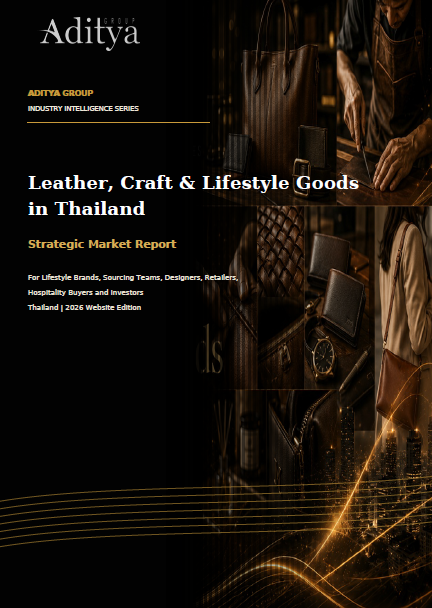
Leather, Craft & Lifestyle Goods in Thailand
Comprehensive insights into the Thailand industry landscape, covering market dynamics, key trends, opportunities, and how businesses can grow and succeed in this evolving market.
Market
Intelligence
Strategic
Insights
Opportunity
Analysis
Informed
Decisions
Lifestyle/fashion exports >USD 9.7B (2024)
Market Signal
Design-led; 8+ trends
Key Trends
Thai craft, hospitality gifts, sustainable lifestyle
Growth Drivers
Medium-High
Strategic Relevance
Thailand's leather, craft and lifestyle goods industry sits at the intersection of manufacturing, design, tourism, culture, SME entrepreneurship and export promotion. The sector is not a single industrial category; it includes leather goods and footwear, handmade and semi-handmade craft, home and lifestyle accessories, gifts, fashion accessories, hotel/resort lifestyle products, Thai design goods, souvenir products, premium packaging, wellness-related lifestyle goods and sustainable-material products
File Size: 2.4 MB
PDF / DOC
Detailed analysis, data insights, and expert perspectives.
Increasing domestic and international demand across key segments.
Innovation and digital adoption are reshaping the industry.
ESG and green practices driving responsible
growth.
Government initiatives and incentives boosting investor confidence.
Strong export outlook with access to global markets.
Market Entry
End-to-end support for successful market entry.
Strategic Advisory
Actionable strategies to accelerate growth and competitiveness.
Business Matching
Connect with the right partners and opportunities.
Sourcing & Supply Chain
Reliable sourcing and efficient supply chain solutions.
Regulatory Guidance
Navigate regulations and compliance with confidence.
Growth Partnerships
Long-term partnerships to unlock sustainable growth.
Thailand’s lifestyle and fashion sector is supported by a combination of SMEs, design entrepreneurs, exporters, craft communities, trade fairs, hospitality demand and government export-promotion activity. STYLE Bangkok 2025, organized by the Department of International Trade Promotion and the Board of Trade of Thailand, brought together more than 440 exhibitors and was expected to generate at least THB 1.6 billion in trade value. The same official event communication stated that Thai lifestyle and fashion exports generated more than USD 9.7 billion in 2024 and were projected to exceed USD 10 billion in 2025.
The sector is SME-heavy. The STYLE Bangkok 2025 communication highlighted that more than 90% of the lifestyle and fashion industry is made up of SMEs and supports more than two million jobs across Thailand. This creates a deep supplier ecosystem, but it also means that foreign buyers and brand owners need strong supplier screening, product-development coordination and quality-control systems.
Leather goods and related accessories represent a narrower but important sub-category. World Bank WITS / UN Comtrade data show Thailand exported USD 41.4 million of articles of leather or composition leather under HS 420500 in 2024, with Japan, Malaysia, India, the Netherlands and the Philippines among key destinations. Footwear is a related manufacturing and export category, with WITS showing the United States, France, Japan, China and Myanmar as key partner countries for Thailand’s footwear exports in latest available data.
Thailand’s jewelry and premium lifestyle ecosystem also strengthens the broader positioning of Thai craft and design. The Gem and Jewelry Institute of Thailand reported gem and jewelry exports of USD 24.75 billion for January-November 2025, or USD 12.85 billion after deducting unwrought gold, indicating the commercial depth of Thailand’s design, finishing, trading and premium-product ecosystem.
Why Thailand is relevant for this sector
- Strong cultural design identity: Thai motifs, natural materials, spa culture, hospitality aesthetics, tropical lifestyle and craftsmanship create storytelling advantages.
- Export and trade-fair infrastructure: DITP, STYLE Bangkok, Bangkok Gems & Jewelry Fair and ThaiTrade channels support buyer discovery and international promotion.
- SME supplier depth: Thailand has many small and medium producers capable of craft, semi-industrial and niche lifestyle production.
- Hospitality and tourism linkage: hotels, resorts, wellness venues and tourist destinations create domestic demand for distinctive lifestyle goods and premium gifts.
- Regional sourcing position: Thailand can combine local production with ASEAN and China sourcing, quality upgrades, packaging and export coordination.
Creative-economy momentum: agencies and regional design festivals support the movement from local craft to commercially relevant design products.
For Aditya Group’s industry-report series, Leather, Craft & Lifestyle Goods refers to products where material, design, craft, usability and brand perception drive value. The category overlaps with fashion, tourism, hospitality, home decor, gifting, wellness, export trading and creative-economy development.
Segment | Representative products | Business model relevance |
Leather goods | Handbags, wallets, belts, travel goods, small accessories, leather organizers, premium corporate gifts. | Sourcing, OEM/ODM, private label, export, boutique retail and corporate gifting. |
Footwear and fashion accessories | Leather footwear, casual footwear, sandals, fabric/leather accessories, hats, scarves and wearable lifestyle products. | Manufacturing partnership, distribution, brand extension and regional retail. |
Craft and artisan products | Wood, bamboo, ceramic, metal, textile, natural-fiber, handwoven and mixed-material products. | Design upgrade, catalog curation, export packaging and storytelling. |
Home and lifestyle goods | Decor, tableware, storage, wellness accessories, hospitality amenities and lifestyle collections. | Hotel procurement, concept retail, export showroom and Thai Aesthetics platform fit. |
Gifts and souvenirs | Premium souvenirs, institutional gifts, corporate gifts, event gifts and destination-branded merchandise. | B2B gifting, custom development, packaging and fulfillment. |
Sustainable lifestyle goods | Recycled, natural, biodegradable, upcycled, low-waste or community-based products. | ESG-aligned gifting, retail differentiation and export positioning. |
The report excludes mass apparel, basic textiles, raw hides, commodity tannery operations and pure luxury retail unless they directly connect to leather, craft, lifestyle goods, sourcing or Thailand-based product commercialization.
Trend | What is changing in Thailand | Strategic meaning for companies |
From souvenir to lifestyle brand | Thai craft is moving from tourist souvenir shelves to design-led home, hospitality, wellness and gift collections. | Products need design consistency, packaging, catalog structure and export-grade specifications. |
Sustainability is becoming a buying filter | Buyers increasingly ask about natural fibers, recycled content, low-waste packaging, community sourcing and responsible materials. | Suppliers must document materials, claims and compliance; generic eco wording is no longer enough. |
Small suppliers need professionalization | Many producers have craft capability but weak costing, QC, export documentation and B2B response systems. | Intermediaries who can manage supplier readiness, sampling, pricing and delivery add material value. |
Hospitality demand creates premium niches | Hotels, resorts, spas and branded residences need amenities, gifts, room accessories and wellness-linked products. | Lifestyle goods can be designed for hotel procurement rather than only retail shelves. |
Customization is a growth driver | Corporate buyers, hospitality groups and retailers want branded, limited-edition or destination-specific products. | OEM/ODM capability, MOQ discipline and packaging development become competitive advantages. |
Digital discovery is changing buyer behavior | International buyers research suppliers through websites, catalogs, marketplaces, LinkedIn and trade-fair directories before meeting. | Suppliers need high-quality images, clear product specs, professional catalogs and quick response workflows. |
Premium craft requires storytelling | Customers pay more when material, origin, maker, function and design narrative are credible. | Brand architecture and product storytelling must be factual, elegant and export-market appropriate. |
Compliance pressure is rising | Leather, dyes, adhesives, packaging, labeling, origin, CITES-sensitive materials and ESG claims can affect export acceptance. | Early compliance review reduces shipment delays, buyer disputes and reputational risk. |
The sector is attractive because it is creative and fragmented, but the same fragmentation creates execution risk. A strong product idea can fail if the supplier cannot repeat quality, if packaging is unsuitable for export, if cost structure is unclear, or if buyers cannot see a credible path from sample to commercial delivery.
Risk | Why it matters | Mitigation approach |
Supplier inconsistency | Small producers may deliver beautiful samples but inconsistent bulk orders. | Use sample approval standards, QC checklists, pre-shipment inspection and staged orders. |
Weak costing discipline | Handmade products can have variable labor cost, waste and material fluctuation. | Build transparent costing, MOQ tiers, lead-time assumptions and contingency planning. |
Design-copy risk | Popular designs may be copied or suppliers may reuse buyer concepts. | Use NDAs, design ownership clauses, limited sample sharing and supplier segmentation. |
Material compliance risk | Leather, dyes, adhesives, wood, bamboo or recycled claims may not meet buyer requirements. | Confirm materials early and test where destination-market risk is material. |
Export packaging failures | Craft products can break, deform, absorb moisture or arrive poorly presented. | Design packaging for export logistics, not only showroom display. |
Channel mismatch | A product suitable for boutique retail may not suit corporate gifting or hotel procurement. | Define target buyer and channel economics before product development. |
Price competition | Thailand may be more expensive than mass producers in China, Vietnam or Cambodia. | Compete on design, quality, curation, customization and service, not only unit price. |
Greenwashing exposure | Eco and community claims are attractive but increasingly scrutinized. | Use factual sustainability statements and retain evidence. |
The competitive landscape is fragmented. Thailand competes with China, Vietnam, India, Indonesia, Cambodia and other ASEAN producers in different parts of the leather, craft and lifestyle goods value chain. Thailand is rarely the cheapest source for mass-volume lifestyle goods. Its advantage is stronger where design, small-to-medium production, customization, hospitality relevance, finishing, cultural storytelling and buyer service matter.
Participant map
Participant type | Strengths | Common limitations |
Small artisan producers | Authenticity, craftsmanship, local identity and flexibility. | Limited capacity, inconsistent documentation, weak export systems and variable QC. |
SME lifestyle manufacturers | Adaptability, small-batch production and mixed-material capability. | May need design direction, buyer communication and production planning support. |
Leather workshops / factories | Material know-how, product finishing, accessories and corporate gift adaptation. | Quality varies; hardware, stitching and edge finishing need strict checking. |
Large regional factories | Scale, price, process and export experience. | Less distinctive design; smaller customized orders may not be prioritized. |
Design brands | Strong identity, retail presentation and storytelling. | Higher prices, limited OEM flexibility and smaller supply capacity. |
Trading companies / agents | Supplier access and transaction coordination. | Quality varies; may lack strategic product development or brand-building capability. |
Practical buying considerations
- Do not assess suppliers only by samples. Repeatability, lead time, defect handling and communication discipline are equally important.
- For leather goods, inspect material grade, hardware, stitching, edge painting, lining, zipper quality, smell, color fastness and packaging durability.
- For craft goods, inspect finishing consistency, moisture sensitivity, breakage risk, packaging strength and export packing standards.
- For lifestyle products, evaluate whether the range works commercially as a collection, not only as individual items.
- For corporate gifting and hospitality, manage branding method, color matching, deadline discipline and approval workflows carefully.
Thailand offers opportunities across sourcing, design-led exports, private label, hospitality procurement, corporate gifting, destination retail and online/offline retail distribution. However, buyers must segment the market carefully. A supplier suitable for handmade premium craft may not be suitable for repeatable export production, and a factory suitable for leather accessories may not be the right partner for design-led small-batch collections.
High-potential opportunity areas
- Premium corporate gifting: leather organizers, wallets, pouches, travel accessories, packaging sets, wellness gifts and Thai-design merchandise for companies, banks, hotels and events.
- Hospitality lifestyle products: resort room accessories, spa products, amenity packaging, local craft retail corners, welcome gifts and destination-branded collections.
- Export-oriented craft collections: curated home decor, ceramic, wood, woven, bamboo, textile, leather and mixed-material ranges for concept stores and distributors.
- Private label and OEM lifestyle goods: design adaptation, logo application, packaging, bundled gift sets and buyer-specific collections.
- Sustainable and community-based product lines: natural fibers, upcycled materials, recycled packaging, community craft and ESG-aligned merchandise.
- Thai Aesthetics platform integration: products can be structured into export-ready collections with proper images, specifications, MOQs, packaging and buyer-facing presentation.
- Regional distribution: Thailand can act as a showroom, product-development and distribution hub for ASEAN lifestyle products.
Opportunity matrix
Opportunity | Demand driver | Execution requirements |
Leather accessories and travel goods | Premium gifting, retail, travel recovery and lifestyle branding. | Material selection, finishing QC, hardware quality, packaging and HS classification. |
Craft-based home lifestyle | Hospitality, concept retail, export buyers and sustainable living trends. | Design curation, catalog consistency, dimensional specs, export packing and supplier continuity. |
Corporate and institutional gifts | Events, banking, property, hospitality, trade promotion and executive gifting. | Branding, MOQ planning, lead-time management, QC and delivery coordination. |
Hotel/resort merchandise | Tourism recovery, destination branding and guest-experience monetization. | Product fit, local storytelling, margin planning, packaging and replenishment model. |
Sustainable lifestyle goods | ESG procurement, eco-conscious consumers and brand differentiation. | Claim verification, material documentation and credible sustainability story. |
Design-led export collections | Global buyers seeking differentiated Asian products. | Range planning, pricing architecture, buyer communication and export documentation. |
Client need | Aditya Group support | Typical output |
Market research and opportunity assessment | Assess demand, channels, competitor positioning, pricing bands and buyer segments. | Industry brief, opportunity map, target-buyer profile and go/no-go recommendation. |
Supplier and product sourcing | Identify and screen leather, craft, lifestyle and packaging suppliers in Thailand and the region. | Supplier shortlist, capability matrix, sample plan and risk notes. |
Product development and OEM/ODM coordination | Translate buyer ideas into specs, samples, packaging and production feasibility. | Product brief, sample tracker, costing sheet, MOQ plan and production calendar. |
Thai Aesthetics platform integration | Prepare curated products for B2B presentation and export-facing digital cataloging. | Product pages, image standards, specifications, category mapping and buyer-ready catalog. |
Corporate gifting and hospitality solutions | Develop branded gift sets, hotel products, welcome gifts and customized lifestyle merchandise. | Proposal, mockups, supplier plan, packaging options and delivery schedule. |
Export and compliance coordination | Support HS classification review, document readiness, labeling and shipment coordination. | Export checklist, document pack and logistics coordination support. |
Distribution and partner matching | Find distributors, retailers, hotels, corporate buyers or export buyers. | Partner map, outreach plan, meeting coordination and negotiation support. |
Execution support | Coordinate samples, production follow-up, inspection, communication and issue resolution. | Project tracker, QC updates, delivery monitoring and buyer communication. |
Where Aditya Group is especially relevant
- Foreign brands looking for Thailand-based sourcing, custom development or lifestyle-product partnerships.
- Hotels, resorts and corporate buyers seeking distinctive Thai or Asia-origin gifts and lifestyle products.
- Thai producers who need to move from local craft selling to export-ready B2B presentation.
- Distributors and retailers seeking curated, differentiated lifestyle products rather than generic catalog items.
- Investors and entrepreneurs evaluating lifestyle, gifting, hospitality retail or Thai Aesthetics-aligned opportunities.
Download the full report or connect with our experts to discuss how we can help you grow in this dynamic market.