
Thailand Industry Report
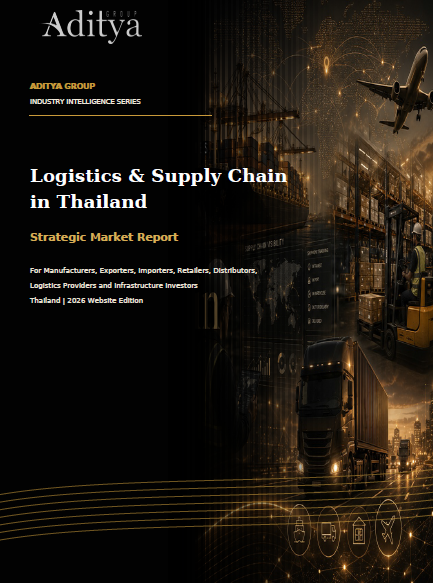
Logistics & Supply Chain in Thailand
Comprehensive insights into the Thailand industry landscape, covering market dynamics, key trends, opportunities, and how businesses can grow and succeed in this evolving market.
Market
Intelligence
Strategic
Insights
Opportunity
Analysis
Informed
Decisions
THB 2.53T logistics cost; 14.1% GDP
Market Signal
Visibility-led; 8+ trends
Key Trends
E-commerce, warehousing, cold chain, corridors
Growth Drivers
Very High
Strategic Relevance
The logistics and supply chain industry includes the physical, digital and commercial systems used to move, store, clear, track and deliver goods. In Thailand, it is directly linked to manufacturing, export-import trade, modern retail, e-commerce, tourism and hospitality supply, healthcare/pharma distribution, agro-food processing, automotive, electronics, consumer goods and industrial development.
File Size: 2.4 MB
PDF / DOC
Detailed analysis, data insights, and expert perspectives.
Increasing domestic and international demand across key segments.
Innovation and digital adoption are reshaping the industry.
ESG and green practices driving responsible
growth.
Government initiatives and incentives boosting investor confidence.
Strong export outlook with access to global markets.
Market Entry
End-to-end support for successful market entry.
Strategic Advisory
Actionable strategies to accelerate growth and competitiveness.
Business Matching
Connect with the right partners and opportunities.
Sourcing & Supply Chain
Reliable sourcing and efficient supply chain solutions.
Regulatory Guidance
Navigate regulations and compliance with confidence.
Growth Partnerships
Long-term partnerships to unlock sustainable growth.
Thailand’s logistics position is supported by its central mainland Southeast Asia location, strong manufacturing base, established export ecosystem and connectivity to Laos, Cambodia, Myanmar, Malaysia, Vietnam and China-linked corridors. Bangkok and the Eastern Economic Corridor remain the most important logistics demand centers, while border provinces and regional hubs support cross-border and domestic distribution.
The Third Thailand Logistics Development Plan sets the national direction around infrastructure development, supply chain value, customs facilitation, logistics performance and innovation. This policy framing matters because logistics is increasingly seen as a competitiveness system rather than a transport cost line item.
The government’s 2025-2026 infrastructure development plan includes hundreds of transport projects across connectivity, safety and sustainability, with announced budgets of THB 136.49 billion for 2025 and THB 116.96 billion for 2026. For logistics companies and industrial investors, the benefit is not immediate everywhere, but corridor-by-corridor improvements can reshape site selection and route economics.
Priority logistics geographies
Cluster | Role in supply chain | Relevant client use cases |
Bangkok Metropolitan Region | Consumption center, head offices, marketplaces, retail channels, last-mile distribution and air cargo access. | E-commerce, consumer goods, healthcare, retail distribution, importer setup, sales channels. |
Eastern Economic Corridor / Chonburi-Rayong-Chachoengsao | Manufacturing, automotive, electronics, industrial estates, port access and export production. | Regional distribution, factory setup, supplier development, warehouse/site selection, export logistics. |
Laem Chabang / Eastern Seaboard | Thailand’s most important container port ecosystem and maritime gateway. | Sea freight, bonded warehousing, customs, export consolidation, industrial cargo. |
Suvarnabhumi / Airport corridor | Air cargo, time-sensitive shipments, samples, pharma, electronics and premium goods. | High-value imports/exports, cold chain, emergency logistics, international samples. |
Border corridors | Trade with CLMV, China-linked rail/road routes and regional distribution. | Cross-border trucking, customs support, regional market entry, trading operations. |
The logistics and supply chain industry includes the physical, digital and commercial systems used to move, store, clear, track and deliver goods. In Thailand, it is directly linked to manufacturing, export-import trade, modern retail, e-commerce, tourism and hospitality supply, healthcare/pharma distribution, agro-food processing, automotive, electronics, consumer goods and industrial development.
Core segments covered in this report
- Freight forwarding and customs brokerage: documentation, carrier coordination, customs clearance, shipment planning and trade compliance.
- Road freight and trucking: factory-to-port, factory-to-warehouse, domestic distribution, cross-border trucking and route optimization.
- Sea freight and port logistics: containerized shipping, bulk cargo, tankers, port handling, depot services and freight consolidation.
- Air cargo: high-value electronics, urgent shipments, perishables, samples, medical products and time-sensitive exports.
- Warehousing and distribution centers: general storage, bonded warehouses, built-to-suit facilities, fulfillment centers and inventory control.
- Cold chain logistics: temperature-controlled warehouses, refrigerated transport, food, pharma and premium grocery distribution.
- Last-mile and e-commerce logistics: parcel networks, COD, reverse logistics, marketplace fulfillment and same/next-day delivery.
- Supply chain consulting and operating support: sourcing, vendor coordination, inventory planning, route-to-market, quality control and logistics cost optimization.
What is outside the scope
This report does not treat logistics as a pure real-estate topic or only as infrastructure construction. It focuses on the operating supply chain: how goods move, where they are stored, how they are cleared, how risks are controlled and how clients can build an efficient Thailand-based logistics model.
Trend | What is changing | Strategic meaning |
Supply chain resilience replaces lowest-cost logistics | Companies are diversifying suppliers, building safety stock and reviewing reliance on single routes or single origins. | Thailand can win if logistics planning is linked to sourcing, warehousing and customs readiness. |
E-commerce and omnichannel reshape distribution | Marketplace sellers, brands and retailers need fulfillment, reverse logistics, COD, tracking and inventory accuracy. | Warehouse and last-mile choices are now commercial strategy decisions, not back-office decisions. |
Warehouse market becomes more segmented | General warehouse supply is expanding, while demand is shifting toward e-commerce, cold chain, specialized users and ESG-aligned facilities. | Clients need location/service benchmarking and should avoid choosing facilities on rent alone. |
Cold chain demand strengthens selectively | Food, ready-to-eat, frozen products, pharma and premium grocery require temperature control and compliance evidence. | Opportunity exists for quality cold-chain partners, but electricity cost and service discipline matter. |
Sea freight remains central but volatile | Geopolitics, alliances, freight cycles, IMO rules and port congestion can shift cost and schedules. | Forwarder selection, route planning, Incoterms and documentation control are essential. |
Digital visibility becomes expected | IoT, WMS, TMS, API tracking and data dashboards are moving from optional to expected. | Clients need logistics partners that can provide control and exception management, not only transport. |
ESG and green logistics rise | Warehouse energy efficiency, EV fleets, modal shift, packaging reduction and emissions reporting are gaining importance. | Exporters and global brands need sustainability-ready supply chain data and operational proof. |
Cross-border logistics gets more strategic | Thailand’s links to Laos, Cambodia, Myanmar, Malaysia and China routes create regional opportunities but also documentation and border-risk complexity. | Companies need local route knowledge, customs support and risk buffers. |
Risk | Typical issue | Mitigation |
Customs delay | Incorrect HS code, missing license, unclear valuation or incomplete documents. | Pre-check documentation, classification and approvals before shipment. |
Hidden landed cost | Freight, port fees, demurrage, storage, duty, VAT and last-mile costs underestimated. | Build full landed-cost model before pricing. |
Supplier coordination failure | Late production, poor packing, wrong labeling or incomplete export docs. | Use vendor checklist, inspections and shipment readiness controls. |
Warehouse mismatch | Cheap warehouse lacks systems, staff, location or service capability. | Benchmark total service cost and operational fit. |
Cold chain failure | Temperature excursion, poor loading practices or inadequate monitoring. | Use SOPs, temperature logging and trained providers. |
Cashflow blockage | Long credit terms, high stockholding, duty/VAT cash outlay and slow collection. | Plan working capital and payment terms with shipment cycle. |
Partner dependency | Single forwarder, single distributor or single transporter creates vulnerability. | Maintain alternative routes and backup providers. |
Regulatory change | Tariffs, border rules, product standards or documentation requirements change. | Monitor rules and keep compliance responsibility clear. |
Thailand’s logistics market is highly fragmented, with global integrators, regional forwarders, Thai trucking companies, warehouse developers, cold-chain specialists, courier networks, customs brokers, marketplace-linked operators and informal small providers. Competition is intense, but service quality varies widely.
Operating realities
- Road freight is flexible and dominant but exposed to fuel cost, driver quality, route discipline, accident risk and delivery reliability issues.
- Sea freight is cost-efficient for heavy and large-volume cargo, but schedule reliability depends on global routes, carrier alliances and port conditions.
- Air cargo is essential for urgent and high-value goods, but it is costlier and sensitive to capacity, documentation and customs readiness.
- Warehousing is shifting from passive storage to technology-enabled fulfillment, inventory accuracy, value-added services and ESG-compliant facilities.
- Cold chain requires operational discipline: temperature logging, SOPs, backup power, loading/unloading control and trained staff.
- Customs brokers and forwarders can make or break the client experience; incorrect HS codes, licenses or documents create delays and penalties.
- Many foreign companies underestimate Thai-language coordination, local vendor management and informal operating details.
Service provider due diligence checklist
Area | Questions to ask | Why it matters |
Licenses and legal status | Is the provider properly registered and licensed for the services offered? | Reduces compliance and counterparty risk. |
Track record | Which industries, cargo types and routes has the provider handled? | Experience must match the cargo profile. |
Systems | Does the provider offer WMS/TMS, tracking, reporting and exception alerts? | Visibility is critical for client control. |
Insurance and liability | What is covered, excluded and claimable? | Damage/loss disputes often arise from unclear liability. |
Customs capability | Can they advise on HS codes, permits, FDA/industrial standards and documentation? | Customs issues can stop commercial launches. |
Financial stability | Can the provider sustain credit terms, peak periods and fuel volatility? | Weak providers create continuity risk. |
Logistics opportunities in Thailand are strongest where clients need integrated execution rather than fragmented services. Many foreign companies can find a forwarder or warehouse. The real value is in designing an operating model that reduces risk, improves delivery reliability and supports commercial growth.
Priority opportunity areas
- Regional distribution hubs: Thailand-based stockholding for ASEAN, CLMV and selected global markets, using a mix of sea, road and air routes.
- Import and distribution setup: importer of record, product registration coordination, customs classification, warehousing and downstream channel support.
- Export consolidation: supplier coordination, quality checks, packaging, documentation, freight booking and buyer shipment coordination.
- Industrial supply chain support: supplier mapping, factory logistics, inbound components, inventory planning and outbound delivery coordination.
- E-commerce fulfillment: inventory management, pick/pack, marketplace integration, last-mile delivery and returns handling.
- Cold chain and controlled logistics: food, spa/wellness, pharma-adjacent, hospitality supply and premium products requiring temperature or quality control.
- Supply chain cost optimization: freight benchmarking, warehouse footprint review, stock policy, packaging optimization and Incoterms review.
- Cross-border trade support: CLMV route planning, documentation, local agents, border risk and regional buyer/supplier coordination.
- Sustainable supply chain design: packaging reduction, ESG-friendly warehousing, emissions data, vendor scoring and supplier compliance.
Aditya Group supports clients at the intersection of market entry, trading, sourcing, operations and execution. For logistics and supply chain projects, the group can help clients design the operating model, identify vendors, structure import/export processes, coordinate suppliers and build practical execution control.
Client need | Aditya Group support | Output |
Thailand logistics feasibility | Assess routes, warehouse locations, customs requirements, landed cost and partner options. | Feasibility note, cost model and execution roadmap. |
Import/export setup | Support company/partner structure, importer/exporter model, customs documentation and approval path. | Operating structure and compliance checklist. |
Sourcing-linked supply chain | Coordinate suppliers, packaging, quality checks, shipment readiness and export documents. | Supplier-to-shipment control process. |
3PL/warehouse partner selection | Identify, screen and compare logistics providers, warehouses, cold-chain operators and brokers. | Shortlist, comparison matrix and negotiation support. |
Route-to-market logistics | Connect inventory plan with distributor, retailer, marketplace, corporate buyer or hospitality customer requirements. | Channel-linked logistics model. |
Cost and risk optimization | Review freight, warehouse, stock policy, Incoterms, insurance and credit terms. | Cost-control and risk-reduction recommendations. |
Ongoing coordination | Act as local execution support between foreign client, Thai suppliers, logistics vendors and customers. | Managed communication, progress tracking and issue resolution. |
Download the full report or connect with our experts to discuss how we can help you grow in this dynamic market.