
Thailand Industry Report
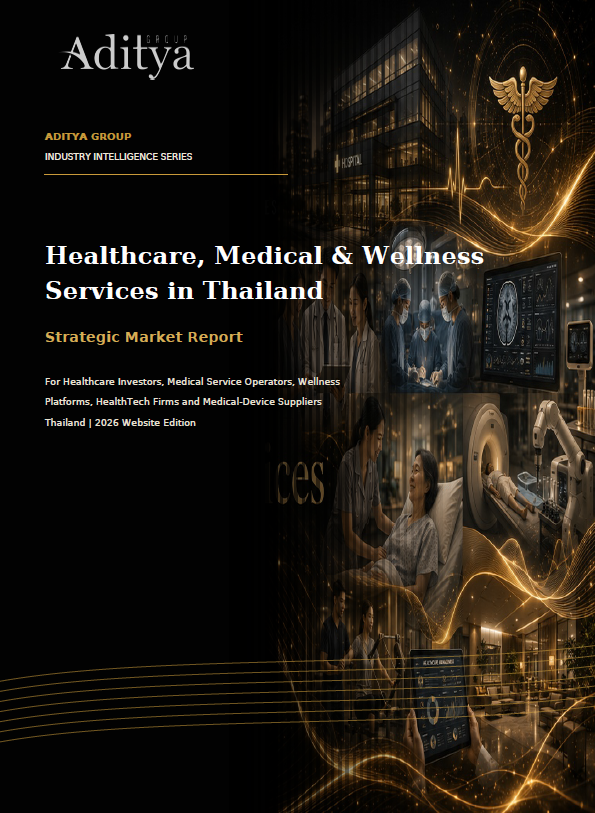
Healthcare, Medical & Wellness Services in Thailand
Comprehensive insights into the Thailand industry landscape, covering market dynamics, key trends, opportunities, and how businesses can grow and succeed in this evolving market.
Market
Intelligence
Strategic
Insights
Opportunity
Analysis
Informed
Decisions
USD 18.3B to USD 26.6B by 2030
Market Signal
Health economy; 6+ trends
Key Trends
Medical tourism, ageing, HealthTech, wellness
Growth Drivers
Very High
Strategic Relevance
Thailand’s healthcare, medical and wellness services industry is moving from a hospital-led medical tourism story to a broader health-economy platform. The market now includes private hospitals, specialty clinics, health check-ups, rehabilitation, elderly care, wellness retreats, aesthetic medicine, home-care services, medical devices, health technology, insurance-linked services and hospitality-integrated wellness journeys.
File Size: 2.4 MB
PDF / DOC
Detailed analysis, data insights, and expert perspectives.
Increasing domestic and international demand across key segments.
Innovation and digital adoption are reshaping the industry.
ESG and green practices driving responsible
growth.
Government initiatives and incentives boosting investor confidence.
Strong export outlook with access to global markets.
Market Entry
End-to-end support for successful market entry.
Strategic Advisory
Actionable strategies to accelerate growth and competitiveness.
Business Matching
Connect with the right partners and opportunities.
Sourcing & Supply Chain
Reliable sourcing and efficient supply chain solutions.
Regulatory Guidance
Navigate regulations and compliance with confidence.
Growth Partnerships
Long-term partnerships to unlock sustainable growth.
Thailand’s healthcare, medical and wellness services industry is moving from a hospital-led medical tourism story to a broader health-economy platform. The market now includes private hospitals, specialty clinics, health check-ups, rehabilitation, elderly care, wellness retreats, aesthetic medicine, home-care services, medical devices, health technology, insurance-linked services and hospitality-integrated wellness journeys. [1] [2]
BOI positions Thailand as a globally recognised healthcare and wellness destination. Its healthcare services market is projected to rise from USD 18.3 billion in 2024 to more than USD 26.6 billion by 2030 at around 5% CAGR, while private-sector spending is expected to grow faster than public spending. [1]
The industry’s credibility is supported by clinical infrastructure and international service capability. BOI cites 65 JCI-accredited medical facilities as of 18 November 2025, and government communications highlight Thailand’s 2025-2034 medical-hub strategy, designed to develop the country into an integrated medical-industry centre. [1] [2]
At the same time, the sector requires careful execution. Healthcare is trust-sensitive, regulated, relationship-driven and operationally complex. Foreign investors and service providers must assess licensing, ownership structure, clinical governance, Thai FDA requirements, professional staffing, insurance linkages, location strategy, quality assurance, patient-acquisition economics and local partner reliability.
Strategic theme | Implication for investors and operators |
Medical hub, not just hospitals | Growth is shifting toward integrated healthcare, wellness, diagnostics, rehabilitation, elderly services and cross-border patient journeys. |
Premium private care | Private hospitals and specialty clinics continue to attract Thai middle/upper-income patients and international visitors, but competition is intense. |
Wellness convergence | Preventive health, anti-ageing, longevity, spa, nutrition, sleep, mental wellness and rehabilitation are becoming part of the broader healthcare proposition. |
Ageing society demand | Chronic disease, elderly support, home-care devices, rehabilitation, mobility products and health monitoring are structural opportunities. |
Execution gap | Many entrants underestimate licensing, Thai-language operations, doctor networks, patient trust, clinical compliance and channel economics. |
The healthcare, medical and wellness services sector includes curative care, preventive care, rehabilitation, long-term care, clinical support services, medical devices, digital health, wellness tourism and health-adjacent lifestyle services. In Thailand, the industry sits at the intersection of public healthcare, private hospitals, tourism, insurance, real estate, hospitality, medical education, digital infrastructure and government investment promotion.
2.1 Value chain
Layer | Examples | Key economics and success factors |
Primary and preventive care | Check-ups, screenings, diagnostics, chronic disease management, vaccinations, lifestyle medicine | Trust, convenience, doctor access, preventive packages, data continuity and insurance linkage. |
Private hospitals and specialty care | Tertiary hospitals, surgery, oncology, orthopaedics, cardiology, dental, fertility, aesthetic medicine | Clinical reputation, JCI/quality systems, specialist networks, international patient services and pricing transparency. |
Wellness and rehabilitation | Wellness resorts, spa, physiotherapy, sleep programs, nutrition, longevity, anti-ageing, post-operative care | Hospitality-quality service design, outcome credibility, safe referral pathways and differentiated positioning. |
Elderly and home-care ecosystem | Nursing care, assisted living, home monitoring, mobility support, rehabilitation devices, family support | Staff training, regulatory compliance, family trust, service reliability and emergency escalation. |
Medical products and technology | Medical devices, health monitors, hospital systems, telemedicine, cybersecurity, AI diagnostics support, wearables | Thai FDA pathway, technical service, data protection, channel access and after-sales support. |
2.2 Sector boundaries
- Healthcare services: hospitals, outpatient clinics, diagnostic centres, dental clinics, specialty clinics and rehabilitation providers.
- Medical wellness: health check-ups, longevity, preventive care, anti-ageing, integrative medicine, spa and wellness retreats linked to clinical or semi-clinical services.
- Medical products: medical devices, consumables, home-care devices, mobility aids, rehabilitation equipment and diagnostic tools.
- Digital health: hospital IT, patient engagement tools, appointment platforms, remote monitoring, electronic records, clinical workflow systems and cybersecurity.
- Support ecosystem: insurers, hotels, travel agencies, interpreters, patient coordinators, nursing agencies, real estate operators and family-office support services.
4.1 From treatment to lifetime health management
Thailand’s health economy is expanding beyond acute treatment into prevention, rehabilitation and long-term management. Investors should therefore evaluate recurring-care models, memberships, chronic-care programs, preventive screening, wellness packages and family-led healthcare support, rather than viewing the sector as a one-time patient transaction.
4.2 Medical tourism becoming more specialised
Thailand’s medical tourism proposition is shifting from broad affordability to more specialised, trusted care journeys. Government messaging highlights specialisation, Gulf and regional cooperation, beauty and anti-ageing, medical innovation and partnerships across airlines, hotels, spas, rehabilitation centres, travel agencies and insurers. [2]
4.3 HealthTech and hospital digitalisation
Healthcare operators increasingly need appointment automation, patient relationship management, secure medical data handling, digital payments, remote monitoring, cybersecurity, AI-supported workflows and operational analytics. However, adoption depends on clinical governance, PDPA compliance, change management and integration with existing hospital systems.
4.4 Medical devices and home-care demand
Krungsri Research expects domestic medical-device sales to grow around 2.0-3.0% annually in 2026-2027, with opportunities linked to ageing, rehabilitation, home-health monitoring, mobility aids, wearables and emergency/first-aid equipment. [3]
4.5 Wellness moving upmarket
Wellness is becoming more evidence-sensitive. High-value customers increasingly expect credible programs, not only spa experiences. This favours operators that can combine hospitality design with measurable outcomes, qualified professionals, differentiated treatments, nutrition, sleep, rehabilitation, diagnostics and safe referral partnerships.
Trend | Opportunity | Execution requirement |
Longevity and preventive care | Check-up packages, nutrition, biological-age testing, sleep and metabolic programs | Credible clinical partners, safe claims, clear protocols and premium service design. |
Elderly and family health support | Assisted living, nursing coordination, home-care support, rehabilitation and family concierge services | Staff quality, trust, privacy, emergency protocols and recurring service management. |
International patient journeys | Dental, aesthetic, orthopaedic, cardiology, fertility, wellness recovery and executive check-ups | Patient acquisition, multilingual support, hotel/travel integration and transparent pricing. |
Medical devices and health monitoring | Home BP/glucose monitoring, wearables, mobility aids, rehabilitation equipment | Thai FDA classification, local importer, after-sales support and training. |
Clinic and wellness platforms | Specialty clinics, wellness resorts, medical-spa alliances and corporate wellness | Licensing, doctor affiliation, brand trust and operating controls. |
4.6 Customer-segment intelligence
Customer segment | Primary need | Commercial implication |
Thai affluent families | Trusted specialists, discreet service, preventive screening, elderly coordination and fast access | High relationship value; requires Thai-language service, family trust and clear escalation routes. |
International medical tourists | Quality treatment, transparent pricing, travel support, accommodation, recovery and follow-up | Requires bundled journey design, multilingual support, hospital coordination and response discipline. |
Corporate employers | Health checks, wellness programs, mental wellbeing, executive health and productivity-linked outcomes | Requires measurable packages, HR-friendly reporting, privacy safeguards and repeatable service delivery. |
Hospitals and clinics | Technology, devices, patient acquisition, operations, compliance and supplier reliability | B2B sales cycles require decision-maker mapping, product validation and after-sales commitments. |
Hotels and resorts | Wellness differentiation, medical partnerships, premium guest programs and recovery stays | Needs careful partner selection, service design, insurance clarity and guest-safety protocols. |
4.7 Strategic opportunity heatmap
Segment | Demand strength | Entry complexity | Aditya Group assessment |
Executive check-ups and preventive health | High | Medium | Strong fit where hospitals/clinics need premium packaging, corporate access and international patient support. |
Wellness retreats with medical adjacency | High | Medium | Strong fit when positioned around credible partners, safe claims and high-value travel experiences. |
Elderly support and home-care coordination | High | Medium-High | Long-term opportunity driven by ageing and family trust; requires operating discipline and vetted caregivers. |
Medical devices and home monitoring | Medium-High | High | Attractive for distribution/sourcing, but Thai FDA, training and after-sales capability are mandatory. |
HealthTech software | Medium-High | High | Good fit for Arahant/technology capabilities; requires pilot proof, cybersecurity and hospital stakeholder mapping. |
Generic spa/wellness services | Medium | Low-Medium | Crowded market; only attractive with distinctive concept, location, outcomes and hospitality integration. |
Risk | Why it matters | Mitigation approach |
Regulatory misclassification | A product or service may fall under medical-device, healthcare facility, clinic, advertisement or professional-practice rules. | Conduct early regulatory screening and avoid public claims before classification is clear. |
Weak local partner selection | The wrong distributor, clinic partner or service provider can damage trust and delay market entry. | Use structured due diligence, reference checks, pilot KPIs and clear contract controls. |
Overpromising wellness outcomes | Unverified claims can create reputational, regulatory and legal exposure. | Use evidence-based language and separate wellness positioning from medical claims. |
Clinical governance gaps | Healthcare quality failures can have serious consequences beyond commercial loss. | Define accountability, escalation, professional supervision and quality documentation. |
Patient acquisition cost | Medical and wellness leads can be expensive and conversion depends on trust and response speed. | Use segment-specific funnels, referral partnerships and content-backed authority. |
Data and privacy exposure | Health data is sensitive and breaches can damage trust severely. | Implement PDPA-aware data handling, cybersecurity controls and limited-access protocols. |
Thailand’s private healthcare market is competitive, brand-sensitive and relationship-based. Large hospital groups dominate premium medical care, while specialty clinics compete through doctor reputation, location, technology, celebrity influence, pricing and patient experience. Wellness operators compete through location, brand design, service quality, practitioner credibility and package differentiation.
6.1 Competitive realities
- Hospital groups have strong brand equity, doctor networks, insurance relationships and international patient departments.
- Specialty clinics can scale faster but face stronger risks around claims, staffing, quality control and patient trust.
- Wellness operators must differentiate beyond ambience; credible outcomes, repeatable protocols and professional integration are increasingly important.
- Medical-device distributors must manage registration, training, after-sales service, spare parts and hospital procurement relationships.
- HealthTech vendors face long sales cycles because healthcare buyers are cautious about data, interoperability and clinical risk.
6.2 Buyer behaviour
Domestic premium patients often choose providers based on doctor reputation, hospital brand, recommendations, convenience, language, insurance coverage and perceived safety. International patients add other criteria: total package cost, visas, travel logistics, accommodation, post-treatment support and trust in the care pathway. Corporate buyers prioritise measurable value, safety, privacy and employee uptake.
Thailand offers opportunities for both investors entering the market and existing operators seeking growth. The strongest prospects are where clinical credibility, customer experience, operational discipline and partnership execution converge.
Opportunity area | Potential users / investors | Why Thailand is relevant |
Specialty clinics | Foreign medical groups, doctors, investors, aesthetic and dental operators | Thailand has strong private healthcare demand, international patients and high service expectations. |
Medical wellness and recovery | Hotels, resorts, wellness brands, hospitals, travel companies | Thailand can combine clinical access, hospitality, spa, food, travel and long-stay recovery. |
Elderly care and home-care services | Care operators, family offices, insurers, medical-device suppliers | Ageing demographics and affluent families create demand for reliable, discreet and professional support. |
Medical devices and consumables | Device manufacturers, distributors, hospital suppliers, home-care brands | Ageing, chronic disease, rehabilitation and hospital upgrades create recurring demand. |
HealthTech and hospital IT | Software vendors, cybersecurity firms, cloud providers, CRM and workflow platforms | Hospitals and clinics need digital modernisation but require local adaptation and trust. |
Medical tourism partnerships | Hospitals, hotels, insurers, travel agencies, concierge operators | Higher-spending medical/wellness visitors require bundled, coordinated experiences. |
5.1 Opportunity-by-business-model view
Business model | Revenue logic | Critical success factors |
Clinic / specialty centre | Consultation, procedures, packages, memberships and follow-up care | Doctor brand, facility licence, patient conversion, claims control and quality assurance. |
Wellness-resort partnership | Program fees, room revenue, treatment packages, referrals and repeat retreats | Hotel alignment, qualified practitioners, safety protocols, measurable experience and premium positioning. |
Medical-device distribution | Importer margin, distributor margin, service contracts, consumables and replacement parts | Registration, hospital access, product training, inventory, service support and documentation. |
HealthTech SaaS / implementation | Subscription, implementation fees, support, integration and data services | Hospital stakeholder mapping, cybersecurity, PDPA controls, localisation and ROI proof. |
Elderly care coordination | Monthly retainers, caregiver management, emergency support, vendor coordination and family reporting | Trust, background checks, service-level discipline, privacy and escalation design. |
5.2 Priority opportunity filters
- Does the model solve a specific healthcare or wellness pain point, rather than only relying on Thailand’s broad medical-hub reputation?
- Can the service be operated legally with the right licences, professionals, claims and supervision?
- Is there a clear local partner or channel with access to patients, hospitals, hotels, corporates or distributors?
- Can the company explain its quality standard, patient-safety process, data protection and complaint-handling process?
Is the pricing commercially viable after partner margins, marketing costs, staffing, compliance, rent and after-sales obligations?
Client need | Aditya Group support |
Market intelligence and opportunity assessment | Segment sizing, buyer mapping, competitor scan, regulatory-route screening, pricing benchmarks and channel analysis. |
Thailand entry strategy | Entry model selection, company setup roadmap, BOI relevance review, partner strategy and staged execution plan. |
Business matching and partnerships | Hospital, clinic, wellness, hotel, distributor, insurer, travel and service-provider identification with structured outreach. |
Medical-device and health-product entry support | Importer/distributor mapping, Thai FDA pathway coordination through qualified specialists, pricing and after-sales model review. |
HealthTech and enterprise software support | Hospital/clinic buyer mapping, pilot design, cybersecurity positioning, local representation and implementation coordination. |
Wellness and medical tourism packages | Partnership model design across hospitals, hotels, wellness providers, concierge support and travel coordination. |
Execution oversight | Project governance, vendor coordination, milestone control, local troubleshooting and management reporting. |
Download the full report or connect with our experts to discuss how we can help you grow in this dynamic market.