
Thailand Industry Report
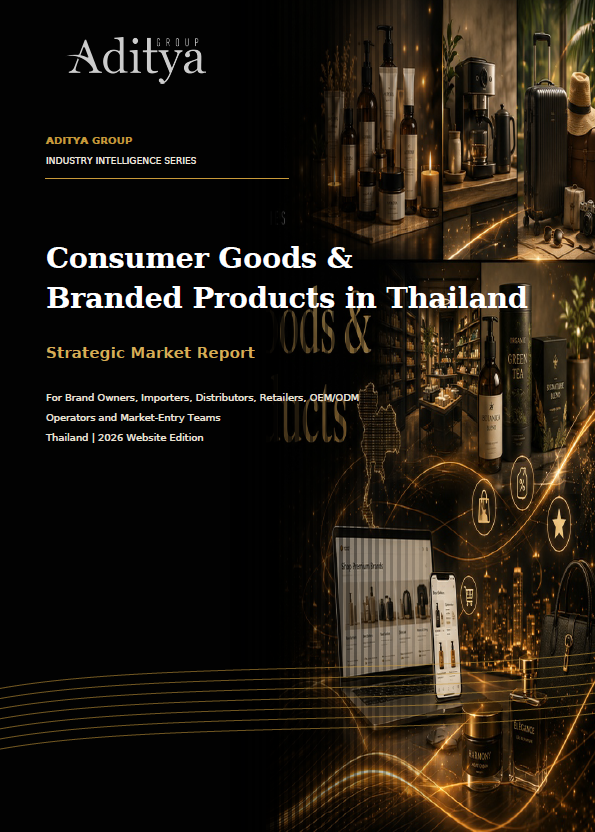
Consumer Goods & Branded Products in Thailand
Comprehensive insights into the Thailand industry landscape, covering market dynamics, key trends, opportunities, and how businesses can grow and succeed in this evolving market.
Market
Intelligence
Strategic
Insights
Opportunity
Analysis
Informed
Decisions
USD 23.45B e-commerce outlook
Market Signal
Omnichannel; 5+ trends
Key Trends
Private label, social proof, affordable premium
Growth Drivers
High
Strategic Relevance
Thailand’s consumer-goods and branded-products market is a sophisticated, highly competitive and increasingly omnichannel market. It combines strong modern retail infrastructure, influential convenience-store networks, social commerce behaviour, tourist spending, brand-conscious urban consumers, provincial distribution networks, and a well-developed sourcing and manufacturing ecosystem. For new entrants, the opportunity is not simply to “sell products in Thailand”; it is to build a credible product-market-channel fit. [1] [2] [3]
File Size: 2.4 MB
PDF / DOC
Detailed analysis, data insights, and expert perspectives.
Increasing domestic and international demand across key segments.
Innovation and digital adoption are reshaping the industry.
ESG and green practices driving responsible
growth.
Government initiatives and incentives boosting investor confidence.
Strong export outlook with access to global markets.
Market Entry
End-to-end support for successful market entry.
Strategic Advisory
Actionable strategies to accelerate growth and competitiveness.
Business Matching
Connect with the right partners and opportunities.
Sourcing & Supply Chain
Reliable sourcing and efficient supply chain solutions.
Regulatory Guidance
Navigate regulations and compliance with confidence.
Growth Partnerships
Long-term partnerships to unlock sustainable growth.
Thailand’s consumer-goods and branded-products market is a sophisticated, highly competitive and increasingly omnichannel market. It combines strong modern retail infrastructure, influential convenience-store networks, social commerce behaviour, tourist spending, brand-conscious urban consumers, provincial distribution networks, and a well-developed sourcing and manufacturing ecosystem. For new entrants, the opportunity is not simply to “sell products in Thailand”; it is to build a credible product-market-channel fit. [1] [2] [3]
The near-term operating environment is selective. Krungsri Research expects modern trade sales to grow only 1.5-2.5% in 2026 before improving to 3.0-3.5% per year in 2027-2028. Consumer demand is being shaped by high household debt, cautious purchasing behaviour and pressure on middle- to lower-income groups, while middle- to upper-income consumers, tourists and necessity-led categories remain more resilient. [1] [4] [5]
Digital channels are central to brand discovery and conversion. The U.S. International Trade Administration cites E-Commerce Association – Thailand data showing Thailand’s e-commerce market at USD 21.83 billion in 2024 and projected at USD 23.45 billion in 2025. However, marketplace visibility is increasingly paid, algorithm-driven and discount-led, meaning that digital commerce must be treated as a commercial system rather than a free distribution shortcut. [3]
Consumer-goods opportunity is strongest where products combine clear utility, credible claims, differentiated packaging, reliable supply, attractive price architecture and a defined channel strategy. Categories with practical relevance include health and beauty, personal care, pet care, baby/family, home and kitchen, eco-friendly products, branded gifts, travel lifestyle products, tech accessories, wellness-linked products and hospitality-oriented consumer goods.
Strategic theme | Implication for brands and investors |
Value-conscious but selective demand | Consumers are managing spending carefully, but still respond to products that solve real problems, feel premium at accessible prices or carry clear lifestyle value. |
Brand trust matters | In crowded categories, trust is built through packaging, claims discipline, reviews, official-store presence, warranty, after-sales service and visible local support. |
Omnichannel execution is essential | Thailand buyers discover through social media, compare on marketplaces, ask via chat, buy offline or online, and expect fast fulfilment and easy service. |
Private label and OEM are rising | Retailers, hotels, corporates and product owners increasingly seek differentiated products, custom packaging, small-batch testing and export-ready product concepts. |
Compliance is part of brand value | Cosmetics, food, supplements, electronics, pet products, baby goods and sustainability claims require careful product-specific regulatory review. |
Consumer goods include everyday and lifestyle products purchased by individuals, households, companies, hotels and institutions. In Thailand, this report treats the industry broadly: FMCG, personal care, wellness products, home and kitchen products, baby and family goods, pet-care items, corporate gifts, travel lifestyle products, small electronics accessories, eco-products and other branded or private-label products.
2.1 Industry value chain
Value-chain layer | Examples | Critical success factors |
Product concept and specification | Category idea, feature set, materials, formulation, design, packaging, variants and price band | Clear buyer problem, Thai usage fit, differentiated proposition, export compatibility and compliance mapping. |
Sourcing / manufacturing | Thai producers, China/ASEAN suppliers, OEM/ODM factories, packaging suppliers and component vendors | Supplier qualification, MOQ, QC, price stability, lead time, certification, sample discipline and IP/control. |
Brand and packaging | Naming, claims, visual identity, label, inserts, retail display, product photography and marketplace content | Trust, shelf impact, Thai/English copy, legally supportable claims and channel-specific packaging. |
Market access | Importers, distributors, retail buyers, B2B buyers, marketplace stores, social commerce and corporate buyers | Margin economics, buyer proof, trade terms, inventory control, activation budget and partner governance. |
Fulfilment and support | Warehousing, last-mile delivery, service centre, returns, warranty, customer care and reorder process | Availability, reliability, response speed, trust, return handling and repeat purchase. |
2.2 Typical product categories
- Daily-use FMCG: packaged food, non-alcoholic beverages, household cleaning, hygiene and convenience-led consumables.
- Beauty, personal care and wellness: skincare, spa products, hair/body care, aromatherapy, amenities, wellness accessories and Thai herbal positioning.
- Home, kitchen and lifestyle: storage, serving, home organisation, kitchen tools, decorative lifestyle products and hospitality-grade products.
- Pet, baby and family: pet hydration, grooming, toys, baby-care accessories, family lifestyle products and safety-oriented household products.
- Corporate gifts and branded merchandise: premium gifting, eco-gifts, tech accessories, packaging, hospitality gifts and event merchandise.
- Travel and tech lifestyle: portable accessories, small smart devices, travel organisers, wellness gadgets and work-life productivity products.
4.1 The consumer is cautious, but not absent
Thailand’s consumers are not uniformly weak; they are selective. Lower-income consumers are prioritising essentials, while middle- and upper-income consumers continue to spend where they see quality, convenience, identity value, health relevance or credible innovation. Krungsri’s modern-trade outlook specifically points to pressure from a slowing economy but relative support from middle- to upper-income spending and stimulus measures. [1]
4.2 “Affordable premium” is stronger than pure luxury mass retail
In many consumer categories, the commercial space between commodity and luxury is attractive. Products that feel better designed, safer, healthier, more eco-conscious or more giftable can command a premium if the value is visible. This is relevant for Thai Aesthetics categories such as eco-products, home, gifts, personal care, pet care and travel lifestyle products.
4.3 Social proof is a commercial asset
Thai consumers often rely on reviews, influencer cues, live-selling demonstrations, marketplace ratings, LINE/Facebook interactions and visual trust signals. For new products, digital content, reviews, Thai-language explanations and proof of local support can reduce buyer hesitation.
4.4 Private-label and OEM/ODM demand is expanding
Retailers, hotels, wellness operators, corporate buyers and entrepreneurs increasingly look for custom products, lower MOQs, differentiated packaging and quick test launches. This creates opportunities for sourcing, packaging, design, branding, compliance coordination and B2B distribution support.
4.5 Sustainability is becoming operational, not cosmetic
Eco-packaging, recyclable materials, refill concepts, reduced plastic, responsible sourcing and traceable claims are increasingly important. However, sustainability claims must be credible and supported by materials, documentation and clear product logic. Greenwashing risk is rising globally and should be managed before launch. [6]
Trend | Opportunity | Execution requirement |
Health, wellness and self-care | Personal care, spa products, wellness tools, functional lifestyle products and hotel amenities | Claims discipline, Thai FDA review where relevant, sensory design, packaging and trust cues. |
Pet humanisation | Premium pet hydration, grooming, hygiene, treats, accessories and health-oriented products | Safety, durability, hygiene, content education and channel fit across pet shops, vets and online. |
Home lifestyle upgrade | Home organisation, kitchen, decor, entertaining, eco-home and gifting products | Strong photography, packaging, retail display, differentiated design and pricing discipline. |
Corporate and hospitality gifting | Eco gifts, branded tech accessories, welcome kits, guest amenities and premium packaging | Customisation process, lead time, sample control, MOQ, quality assurance and B2B sales materials. |
Marketplace maturity | Official stores, content-led selling, review-building and cross-border testing | Ad budget, content localisation, fulfilment, after-sales support and margin waterfall. |
Risk | Why it matters | Mitigation approach |
Weak consumer purchasing power | Discretionary purchases can be delayed, traded down or promotion-dependent. | Focus on necessity, utility, clear value, smaller packs, bundles and accessible premium positioning. |
Overcrowded categories | Beauty, home, pet, gifts and lifestyle products face many local/imported alternatives. | Use sharper positioning, better packaging, proof, reviews, B2B niches and differentiated channels. |
Margin leakage | Distributor, retailer, platform and promotion costs can eliminate profit. | Prepare full margin waterfall and separate channel SKUs where needed. |
Compliance gaps | Claims, labels, import permissions or product approvals can cause delays or penalties. | Do product-specific regulatory mapping before launch. |
Wrong partner selection | A weak distributor can block the market or damage brand reputation. | Use due diligence, staged targets, pilot periods and non-exclusive first phase. |
Copycats and parallel sellers | Popular SKUs may attract price-cutting and unofficial sellers. | Control official channels, batch tracking, reseller agreements and marketplace monitoring. |
Inventory risk | Slow sell-through locks cash and creates discount pressure. | Launch with controlled stock, reorder triggers and realistic forecast assumptions. |
The competitive environment is intense. Thailand has strong local conglomerates, imported multinational brands, aggressive private-label development, marketplace sellers, parallel imports, Chinese cross-border sellers, local SMEs and niche D2C brands. Winning requires sharper category positioning and disciplined execution rather than simply adding another SKU to the market.
Competitive force | Market impact | Strategic response |
Large local and multinational brands | Strong distribution, advertising budgets and retailer relationships. | Avoid head-on commodity competition; enter with niche, design, function, pricing or sourcing advantage. |
Private label | Retailers can capture price-sensitive consumers and control shelf economics. | Offer differentiated branded value or become a private-label/OEM partner. |
Low-cost imports | Price pressure from China/ASEAN supply and marketplace sellers. | Compete on trust, quality, warranty, packaging, compliance and B2B service. |
Platform sellers | Fast listing, aggressive discounting and review-led competition. | Build official-store credibility, content quality, stock reliability and channel separation. |
Retail gatekeeping | Retail buyers require proof, margin, supply reliability and promotional support. | Prepare buyer-ready pitch, sample pack, margin model and pilot plan before approach. |
6.1 Margin economics matter
Many consumer-goods launches fail because gross margin looks attractive at landed-cost level but collapses after retailer margin, distributor margin, platform fee, advertising, fulfilment, returns, promotions, samples, storage, payment terms and warranty. A disciplined margin waterfall should be prepared for every channel before launch.
Cost / margin layer | Questions to test before launch |
Landed cost | What is the true cost after product, freight, duty, VAT, inspection, labelling, packaging and handling? |
Distributor and retailer margin | Can the product support distributor, retailer and promotional margins without becoming overpriced? |
Digital platform economics | What happens after platform fee, voucher, ads, affiliate/KOL, payment fee, fulfilment and return costs? |
Working capital | How much stock is needed, how fast can it sell, and what payment terms will the channel require? |
After-sales and warranty | Who handles questions, returns, defects, replacements, spare parts or product education? |
Thailand’s consumer-goods opportunity should be assessed by segment, channel and execution complexity. A product may be attractive but still commercially weak if the channel margin is too high, regulatory process is unclear, MOQ is too large, packaging is not localised, or consumer education costs are underestimated.
Opportunity area | Why it is attractive | Aditya Group relevance |
Branded lifestyle imports | Urban consumers and tourists respond to differentiated products with visible quality and design. | Market-entry research, importer/distributor search, pricing, retail pitch and launch execution. |
Thai-inspired export products | Thailand has strong associations with wellness, hospitality, craft, food, spa, natural ingredients and lifestyle design. | Thai Aesthetics product curation, sourcing, brand architecture, packaging and export/buyer positioning. |
Private label / OEM | Retailers, entrepreneurs and hospitality groups want custom products without building full manufacturing capability. | Supplier search, specification, sample management, MOQ negotiation, packaging and compliance coordination. |
Corporate gifts and branded merchandise | Companies need differentiated gifts, event products and premium packaging beyond generic items. | Trading experience, product sourcing, Thai/ASEAN supplier networks, presentation and fulfilment planning. |
Hotel, spa and wellness products | Tourism and hospitality create demand for amenities, retail take-home products, wellness gifts and eco-products. | Travel Motivations and Thai Aesthetics alignment, hospitality buyer targeting and product bundling. |
Pet and family lifestyle | Pet care and family-oriented products are emotionally driven categories where trust and design matter. | Category curation, B2B outreach, product-page content and reseller strategy. |
5.1 High-potential buyer groups
- Retail chains, specialty stores, pharmacies, beauty stores, pet shops, home and lifestyle shops, hotel boutiques and travel retail operators.
- Hotels, resorts, spas, wellness clinics, serviced residences, airlines, tour operators and hospitality procurement teams.
- Corporate buyers, HR teams, event organisers, banks, insurance companies, technology firms and premium gift buyers.
- Entrepreneurs and product owners seeking OEM/ODM products, packaging development and Thailand/ASEAN sourcing.
Foreign brands seeking distributor validation, retail access, official store setup, B2B pilots or Thailand localisation.
Client need | Aditya Group support |
Market research and category validation | Competitor mapping, price benchmarking, consumer/channel analysis, buyer interviews, marketplace review analysis and go/no-go recommendation. |
Thailand market entry | Entry-route design, company/importer/distributor model review, partner search, meeting support and launch planning. |
Sourcing and OEM/ODM development | Supplier identification, sample coordination, MOQ negotiation, specification review, packaging coordination and QC planning. |
Brand localisation and sales assets | Thai/English product positioning, catalogue, buyer presentation, retail one-pager, product-page structure, FAQ and launch messaging. |
Retail and distribution strategy | Channel prioritisation, distributor qualification, retail pitch, margin waterfall, trade terms review and reseller toolkit development. |
Corporate, hospitality and B2B sales | Buyer targeting, proposal preparation, customised gifting/hospitality product bundles and follow-up support. |
Thai Aesthetics platform integration | Category placement, B2B product presentation, export-ready positioning, private-label concepts and AI-enabled product visuals/content. |
Execution support | 90-day launch plan, sales-pipeline tracking, partner coordination, issue resolution and performance review. |
11.1 Practical deliverables
- Consumer-goods market-entry diagnostic: category, competitors, channels, pricing, regulation and route-to-market recommendation.
- Distributor / retailer / B2B buyer shortlist with qualification criteria and meeting notes.
- Product readiness checklist covering label, claims, packaging, images, FAQ, warranty, certificates and samples.
- Channel margin waterfall for distributor, retail, marketplace, B2B and corporate sales models.
- Thai/English buyer presentation and product catalogue suitable for retail, hotel, corporate and distributor meetings.
- 90-day pilot plan with KPIs, inventory assumptions, partner responsibilities, content schedule and review milestones.
Download the full report or connect with our experts to discuss how we can help you grow in this dynamic market.